
Research
AI agent autonomously aligns a synchrotron X-ray beamline in new Nature study
8:30 AM · July 27, 2026
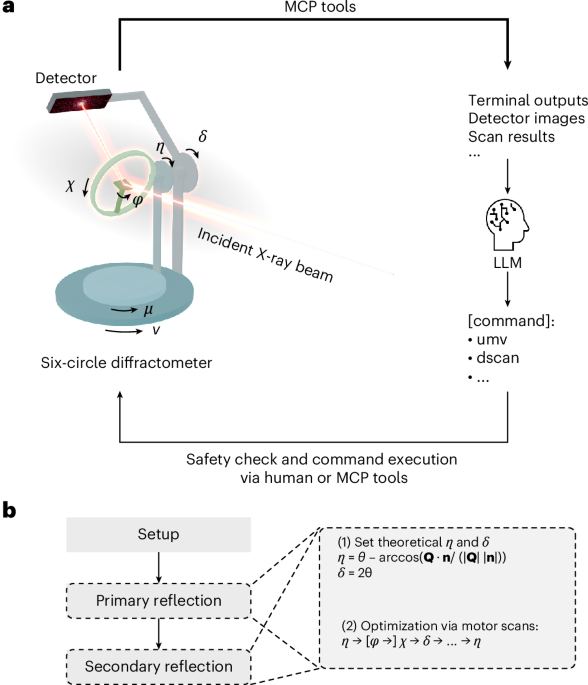
A paper published in Nature Machine Intelligence on July 21, 2026, titled “An agentic artificially intelligent X-ray scientist,” describes a system built by researchers at Stanford University and SLAC National Accelerator Laboratory that can autonomously align single crystals at a working synchrotron beamline, one of the most delicate and time-consuming steps in X-ray experiments. Rather than following a fixed script, the system uses a large language model based agent to interpret live detector feedback and adjust the experimental setup step by step, closing the loop between measurement and action without a human operator manually steering the process. The authors present it as evidence that language model agents can move beyond text and code tasks into physical, instrument-driven science, where decisions must account for noisy real-world feedback and irreversible physical adjustments rather than a simulated environment. Synchrotron beamlines are scarce, expensive shared resources with long queues of researchers waiting for time, so cutting the setup and alignment overhead for each experiment could materially increase the amount of usable science each facility can produce. The paper adds to a growing body of 2026 research on self-driving scientific instruments, alongside similar agent based systems for biomedical evidence synthesis and protein structure prediction that Nature Machine Intelligence has published this year, and suggests large scientific facilities may increasingly treat AI agents as a standard part of their operating infrastructure rather than an experimental add-on.